
EM·05
ENVIRONMENTAL & MUNICIPAL
Skips delivered, placed, exchanged and collected across Duba, Tabuk and the NEOM corridor. The size is matched to your waste and your space — confirmed per order — the hire period fits the job instead of the other way round, and when the skip fills, one message swaps it. Street placement handled per the municipality’s procedures, disposal recorded per load.
Skip full right now? Ask for an exchange — same conversation, real window →
EM·05
Per Order
One Call
Duba
FIG.01 PLACEMENT VISUALIZER
You run this one: place the skip, then call the collection — the loader arrives, lifts, and the pad is clear. Illustrative; sizes and placement are confirmed per order.
drag to rotate · scroll to zoom
3D isn't available in this browser. The loop: the loader truck delivers the skip and sets it on the agreed spot, the skip stays on hire while you fill it, and one message brings the truck back to exchange or collect it — with disposal per the municipality's procedures.
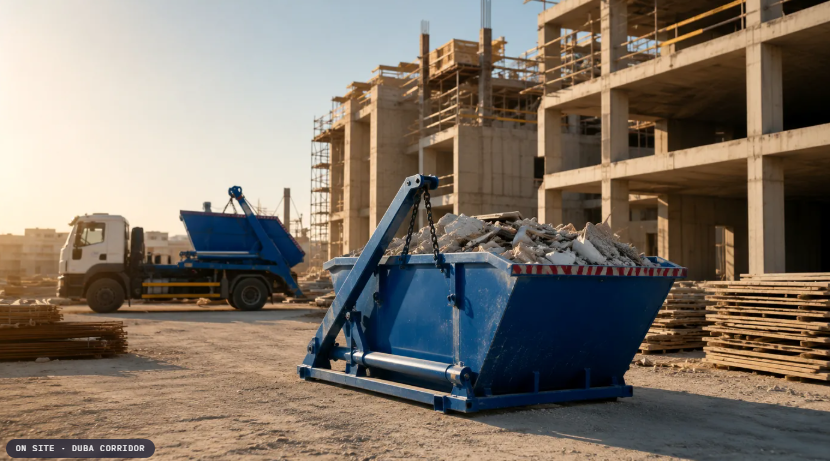
Rubble, offcuts and site debris — the standard skip on the pad.
FIG.02
WHAT THE SERVICE INCLUDES

Skip rental sounds simple — and it is, when six things are handled properly behind the scenes:
STAGE·01
The size is matched to what you’re throwing and where the skip will sit — heavy rubble wants a smaller, stronger unit than light fit-out waste. Sizes and rates are confirmed per order, honestly.
STAGE·02
Ground, access and swing room are checked before the truck arrives. On-plot placement is straightforward; street placement is handled per the municipality’s procedures for that location.
STAGE·03
The period fits the job — a weekend clear-out, a month of fit-out, or an open-ended site arrangement — and extending is one message, not a renegotiation.
STAGE·04
Level loads, nothing hanging over the rim, and no hazardous waste — the rules are stated up front because a skip that can’t be lifted legally helps nobody.
STAGE·05
When the skip fills, one message swaps it for an empty one or collects it outright — with an honest window, because a full skip blocks the exact spot you need.
STAGE·06
Contents go per the municipality’s procedures and designated points, the load is recorded, and the pad is left as the skip found it.
FIG.03
WHO ORDERS SKIPS
JOB·01
Debris off the slab on an exchange rotation that follows the works.
JOB·02
Strip-out waste gone before the next trade arrives.
JOB·03
One skip, one weekend, one collection — done.
JOB·04
Back-of-house skips exchanged around opening hours.
JOB·05
Standing skips for offcuts and scrap, swapped on a rhythm.
JOB·06
Skips in for the build-up, exchanged after the crowd, gone with the fences.
FIG.04
THE DISCIPLINE
A skip should be furniture: it arrives, it works, it leaves. The discipline that makes it that boring —
EM·05 · HIRE CONTROL — SKIP RENTAL
Recommended honestly per order — an oversized skip wastes money, an undersized one wastes two.
The crew that's ready to load shouldn't wait for the container — placement windows are commitments.
Set where agreed, gates and lanes kept clear, street placement per municipality procedures.
No hazardous waste, liquids or batteries — clear before the first load, not argued at collection.
A full skip gets a real swap window immediately — it's blocking the spot you need most.
The pad left as found, the load disposed per municipality procedures, the record kept.
FIG.05
DECISION GUIDE
| Situation | Best arrangement | Why |
|---|---|---|
| One job, one load of waste | Single skip hire (EM·05) | Delivered, filled, collected — priced per order, no contract needed. |
| Works producing waste for weeks | Exchange service | A skip always on the pad — swapped as it fills, on one message. |
| Large site, several waste points | Multiple skips, one account | Units placed per zone, exchanged independently, invoiced together. |
| Daily bagged waste, not debris | Waste route instead — EM·03 | Household-type waste wants a scheduled collection, not a skip. |
Not sure what size? Describe the waste and the space — recommending the unit is our job. Describe the job →
POSITION
You shouldn't be an expert in skips. You should send one message and get your corner of the site back.
Duba · Tabuk · NEOM corridor — sizes per order, exchange on one call.
FIG.06
HOW TO ORDER
STEP 01
Location, what you’re throwing, and where the skip will sit.
STEP 02
Size, rate, hire period and the delivery window — per order, in writing.
STEP 03
Exchange or collection on one message, disposal per municipality procedures, recorded.
FIG.07
VERIFIED REGISTER
APPROVAL
REGISTRATION
COVERAGE
SIZES
PLACEMENT
DISPOSAL
EXCHANGE
Certificates and classifications, packaged for tender files, come with each quotation and on the company facts page →
FIG.08
RELATED SERVICES
EM·03
Daily site waste on a scheduled route — the skip's companion service.
NEM·TBK·DUB
EM·04
When the volume outgrows skips — spoil and debris in truck cycles.
TBK·NEM·RSC
ALL
The full register across transport, marine, environmental and industrial divisions.
GROUP
FIG.09
SKIP REQUEST
Location, waste type and where the skip sits — we confirm size, rate and the window. About 60 seconds.
Your request goes to the environmental services team. Site information is treated confidentially.
Honest sizing
The unit the waste needs — recommended per order, not upsold.
Windows that hold
Delivery and exchange when we said — your crew loads, not waits.
Placement handled
Street placement per municipality procedures — our paperwork, not yours.
PREFER TO TALK?
FIG.10
QUERIES
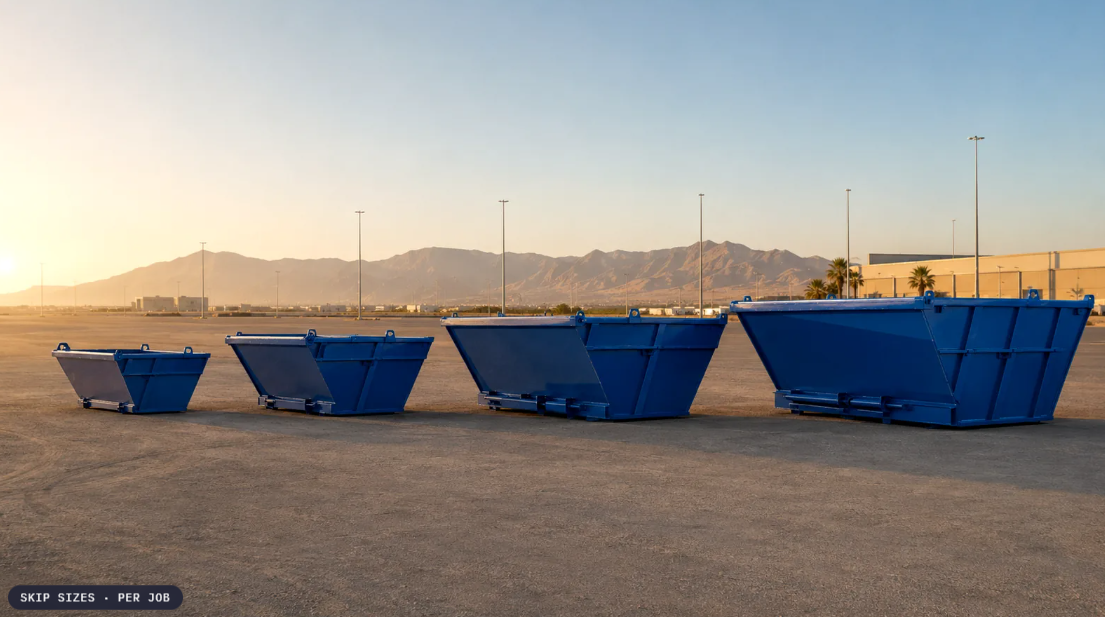
A range of units covering small clear-outs through to construction-site skips — the specific size and rate are confirmed per order, recommended against your waste type and the space available rather than picked from a menu.
As long as the job needs — a weekend, a month, or an open-ended site arrangement. The hire period is agreed per order, and extending it is a single message rather than a renegotiation.
One message: we either exchange it for an empty unit or collect it outright, with a real window confirmed in the same conversation. Sites with continuous waste usually run a standing exchange so a skip is always available.
Hazardous waste, liquids, batteries, gas cylinders and similar restricted items — and loads must stay level with the rim so the skip can be lifted legally. The rules are stated with the order, so there's never a dispute at collection.
Room for the skip plus the loader truck's approach and lifting arms — roughly a truck-length of clear run-up. Send a photo of the spot with your request and the placement is confirmed before the truck moves, not discovered on arrival.
Where the municipality's procedures allow it, yes — the placement is handled per those procedures for that location, arranged as part of the order. On-plot or yard placement needs no approvals and is always the simpler route where space allows.
Answered against real availability — often next morning given the Duba base, but always confirmed before your crew plans around it. If the job is waiting on the skip, say so; those requests are triaged first.
Skips suit debris and bulky waste that accumulates unpredictably; a scheduled route suits daily bagged waste at steady volume. Many sites run both — describe the waste in your request and it gets routed to whichever service actually fits, including a mix.