
Home/Services/Environmental & Municipal/Waste & garbage collection
EM·03
ENVIRONMENTAL & MUNICIPA
Waste, collected on schedule.
Scheduled bin routes and bulk waste collection for camps, sites and commercial facilities across NEOM, Tabuk and Duba. The frequency is sized to your actual volume, every point on the route gets serviced — not skipped — and each collection is recorded, so your HSE file writes itself. Containers provided or serviced per contract, disposal per the municipality’s procedures.
Bins overflowing between pickups? That’s a frequency problem — send the volumes and we’ll re-size it →
SERVICE
EM·03
PATTERN
Per Route
RECORDS
Per Pickup
DISPOSAL
Per Munic.
FIG.01 ROUTE VISUALIZER
Watch a route run point to point.
Pick the container setup and run the route — the truck services each point in sequence, and the gauge tracks route progress. Illustrative; frequencies and container counts are confirmed per contract.
3D · DRAG TO ROTATE
STANDBY
ROUTE PROGRESS
drag to rotate · scroll to zoom
3D isn't available in this browser. The route: the collection truck services each bin point in sequence — every point serviced, spills lifted, the point left clean — and the pickup is recorded before the truck moves on. Details are in the stages below.
Wheelie bins
Standard bins at distributed points — the everyday camp and compound route.
FIG.02
WHAT THE SERVICE INCLUDES
From waste profile to running route.
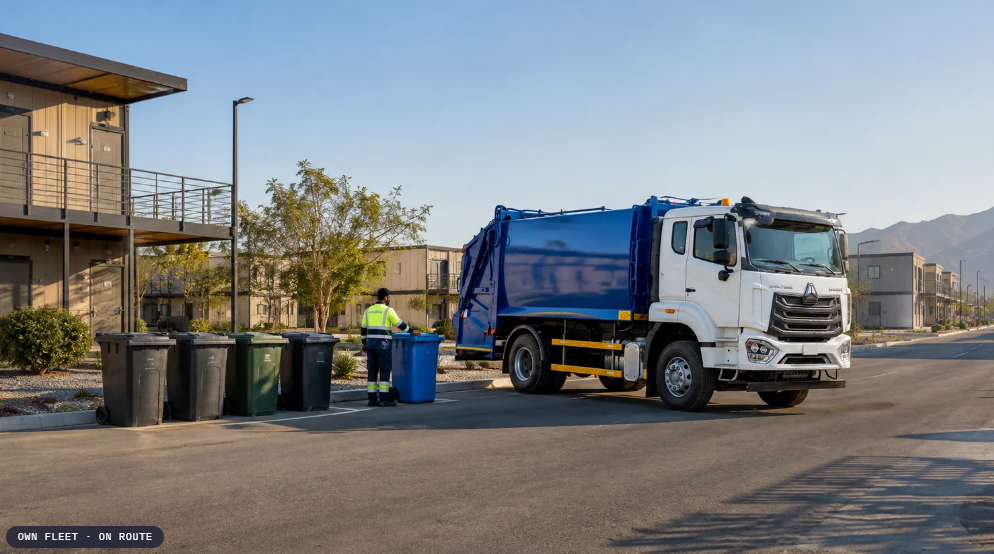
A collection service is a route with a promise attached: every point, every scheduled day, recorded. Here’s what each stage covers.
STAGE·01
The waste profile
What the site produces, roughly how much, and where it accumulates — general and municipal-type waste is the scope here, with hazardous streams excluded and flagged early if they exist.
STAGE·02
Route & frequency
Collection points and pickup days are set from the volume, not the calendar’s convenience. The test is simple: bins are never full when the truck arrives, and never overflowing before it does.
STAGE·03
Containers
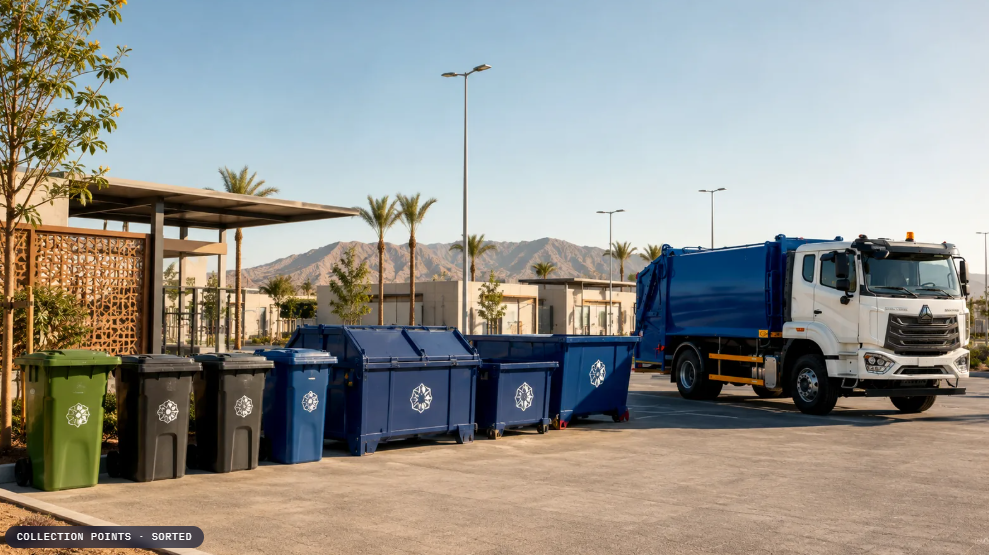
Bins and containers are provided or serviced per contract, matched to each point — wheelie bins at accommodation blocks, bulk bins at kitchens, whatever the point actually needs.
STAGE·04
Collection discipline
Every point on the route gets serviced, lids go back closed, spills around the point are lifted, and the area is left clean. A skipped point is a failure, not a rounding error.
STAGE·05
Records
Each collection is logged — date, point, route — in a format your HSE and camp administration can file directly. When the contractor’s auditor asks, the answer already exists.
STAGE·06
Surges & changes
Mobilization peaks, events, seasonal swings, demobilization — the route flexes with the site, and reviewing it is our job to raise, not yours to chase.
FIG.03
WHO’S ON THE ROUTE
Six kinds of collection point.
PNT·01
Worker camps
High-volume, daily-rhythm routes where a missed day is visible by lunchtime.
PNT·02
Construction sites
General site waste on a schedule that keeps the work areas clear.
PNT·03
Commercial & retail
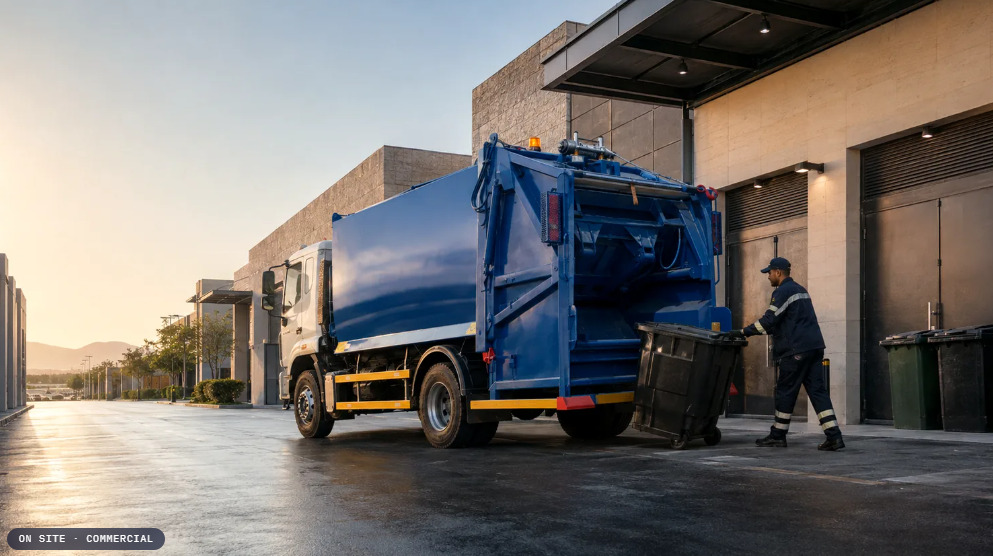
Back-of-house collection timed around opening hours.
PNT·04
Offices & compounds
Quiet, regular routes for places where the service should be invisible.
PNT·05
Catering & mess areas
Kitchen and mess waste on a frequency that respects hygiene, not habit.
PNT·06
Events
Collection that scales up for the crowd and disappears with the teardown.
FIG.04
THE DISCIPLINE
A waste route is a promise with a timetable.
Waste collection fails quietly — one skipped point, one slipped day, and the site smells it before anyone reports it. The discipline is what keeps the promise boring:
EM·03 · ROUTE CONTROL — WASTE COLLECTION
Profile agreed up front
What's collected and what's excluded is written down before the first pickup — no surprises at the bin.
Frequency matched to volume
The route is sized so bins never overflow between pickups; if they do, the frequency is wrong and we fix it.
Containers fit the point
Each collection point gets the container its waste actually needs, provided or serviced per contract.
Every point serviced, none skipped
The route is complete or it isn't done — partial routes are logged as failures, not successes.
Spillage lifted, point left clean
The standard is the area around the bin, not just the bin — collection includes the mess.
A record per collection
Date, point and route logged in a format HSE teams file without reformatting.
FIG.05
DECISION GUIDE
Which arrangement fits the site?
| Situation | Best arrangement | Why |
|---|---|---|
| Ongoing site or camp waste | Scheduled route (EM·03) | Fixed days, sized frequency, records per pickup — the standard arrangement. |
| One-time accumulation to clear | Bulk one-off collection | Priced per pickup; often the first step before a standing route. |
| Camp needing the full loop | Route + EM·01 water + EM·02 sewage | Three services, one schedule, sized to the same headcount. |
| Construction debris, not daily waste | Skips instead — EM·05 | Heavy or bulky debris belongs in an exchanged skip, not a bin route. |
Not sure whether you need a route or skips? Describe the waste — routing it correctly is our job. Describe the site →
POSITION
Nobody inspects a waste service. They just notice — instantly — when it misses a day.
NEOM · Tabuk · Duba — every point serviced, every pickup recorded.
FIG.06
HOW TO START
Three steps to a running route.
STEP 01
Describe the waste
Location, what the site produces, roughly how much, and where it accumulates.
STEP 02
We propose the route
Points, containers, pickup days and price — confirmed in writing per contract.
STEP 03
The route runs
Every point, every scheduled day, recorded — and re-sized as the site changes.
FIG.07
VERIFIED REGISTER
The credentials your vendor team checks.
APPROVAL
NEOM-approved vendor
REGISTRATION
Saudi-registered — Altawfiq General Trade Est.
COVERAGE
NEOM · Tabuk · Duba
SCOPE
General & municipal-type waste; hazardous streams excluded
CONTAINERS
Provided or serviced per contract
DISPOSAL
Per municipality procedures and designated points
RECORDS
Logged per collection, HSE-ready format
Certificates and classifications, packaged for tender files, come with each quotation and on the company facts page →
FIG.08
RELATED SERVICES
Complete the site loop.
EM·05
Waste skip rental
Construction debris and bulky waste — skips exchanged as filled, alongside the bin route.
DUB·TBK·NEM
EM·01
Water tanker supply
The inbound half of the same camp schedule — water sized to the headcount.
TBK·NEM·RSC·DUB
EM·02
Sewage & vacuum tanker
Septic rotations on the same rhythm logic — the loop's second leg.
TBK·DUB·NEM
ALL
View all 14 services
The full register across transport, marine, environmental and industrial divisions.
GROUP
FIG.09
COLLECTION REQUEST
Describe the waste.
Location, what the site produces and roughly how much — we propose the route. About 60 seconds.
Your request goes to the environmental services team. Site information is treated confidentially.
No skipped points
The route is complete or it's logged as a failure — our standard, not yours to enforce.
Frequency that fits
Sized to volume so bins never overflow between pickups.
HSE-ready records
A log per collection your auditors file without reformatting.
PREFER TO TALK?
FIG.10
QUERIES
Waste collection, answered.
General and municipal-type waste — camp, site, commercial and office waste. Hazardous streams are excluded from this service and flagged during the waste profile; if your site produces them, say so early so they're routed correctly.
Containers are provided or serviced per contract — we can supply bins matched to each collection point, or run the route on containers you already own. Either way, the container fits the point, not the other way round.
From your volume, not from a menu. The test is that bins are never overflowing before the truck arrives — if they are, the frequency is wrong, and re-sizing it is our job to raise.
Yes — segregated streams can be collected separately per contract, with containers marked per stream and the routing agreed in the waste profile. Many megaproject contractors require this; the setup is written into the contract so it survives crew changes.
Rhythm and timing. Camps run high-volume routes on a daily or near-daily rhythm sized to headcount; commercial points run around opening hours with quieter, less frequent pickups. Both get the same discipline: every point, every scheduled day, recorded.
A log per collection — date, point and route — in a format your HSE or camp administration can file directly. Disposal runs per the municipality's procedures and designated points, so the trail is complete end to end.
Yes — surges are a scheduling problem, and scheduling is the product. Extra pickups are added for the peak and released after, with the standing route re-sized if the new volume turns out to be permanent.
It's logged as a failure on our side, you're told before you notice, and the point is serviced on a recovery visit — not rolled into the next scheduled day. A route that quietly skips points isn't a route; it's a lottery.