
EM·04
ENVIRONMENTAL & MUNICIPAL
Load. Haul. Tip. Repeat.
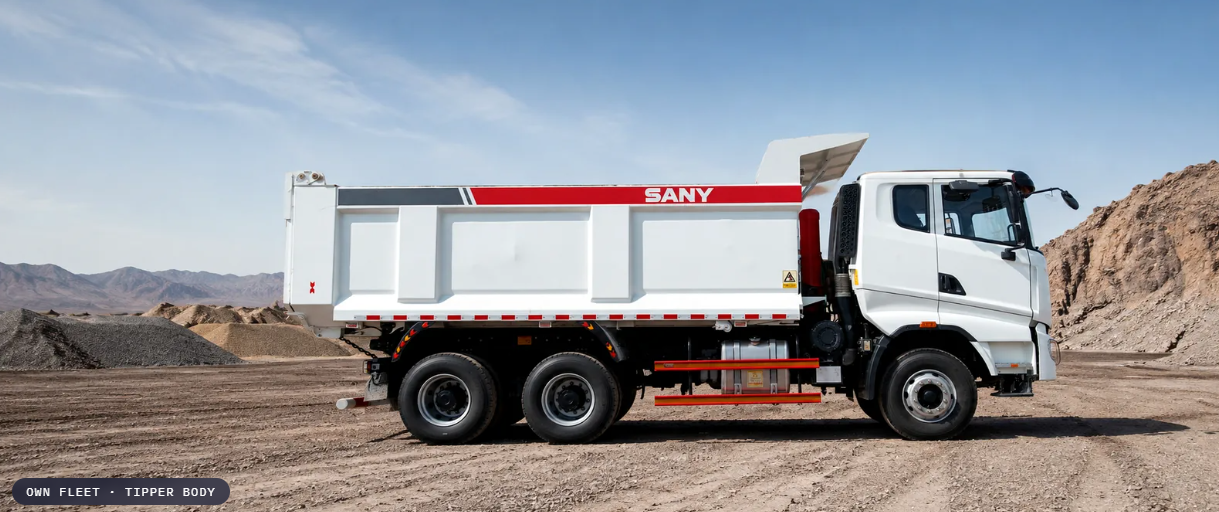
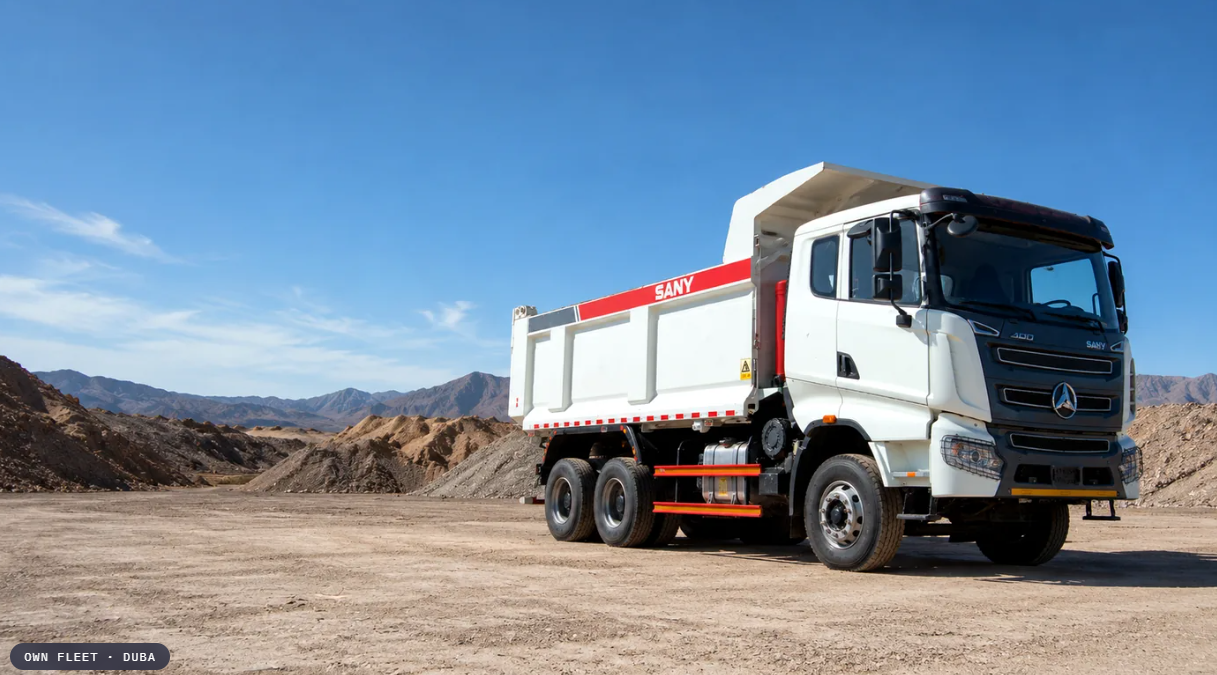
Dumper trucks for excavation spoil, sand, aggregate and debris across Tabuk and the NEOM corridor. The fleet is sized from your cycle time — loading, haul distance, tipping, return — so the excavator never waits for a truck and no truck waits for the excavator. Drivers included, every cycle ticketed, and tipping only at the points your project instructs.
Excavation starting soon? Send the volumes and haul distance — we’ll size the fleet →
SERVICE
EM·04
UNIT
DUMPER
PATTERN
Per Cycle
TIPPING
Per Instruction
FIG.01 CYCLE VISUALIZER
Watch the cycle turn.
Pick the material and start the loop — load at the excavation, haul to the tip zone, tip, return. The counter tracks completed cycles; stop it whenever you like. Illustrative; truck counts and cycle rates are confirmed per program.
3D · DRAG TO ROTATE
STANDBY
COMPLETED CYCLES0
drag to rotate · scroll to zoom
3D isn't available in this browser. The cycle: the dumper is loaded at the excavation, hauls to the tipping point your project instructs, tips, and returns — each cycle counted and ticketed. Details are in the stages below.
Excavation spoil
The core program — spoil off the dig, cycles matched to the excavator.
FIG.02
WHAT THE SERVICE INCLUDES
From program to counted cycles.
Dumper work is arithmetic wearing a hard hat: volume ÷ load × cycle time = the fleet you actually need. Here’s how each stage runs.
STAGE·01
The program
Total volume, haul distance, who loads, and the tipping point your project designates. That’s enough to size the fleet and quote — per day, per cycle or per phase, confirmed in the quotation.
STAGE·02
Matching cycles to the excavator
The fleet is sized from the measured cycle — load, haul, tip, return — so the excavator never idles waiting for a truck. An idle excavator costs more than an extra dumper; the arithmetic decides.
STAGE·03
The haul
On-site roads and public roads are driven to their rules — covered loads where required, legal weights always, site speed limits respected. Drivers are briefed on your site’s rules before the first cycle.
STAGE·04
Tipping
Spoil and debris go only where the project instructs — designated tipping points, per the project’s and municipality’s procedures, never an unofficial shortcut that becomes your problem later.
STAGE·05
Counting & tickets
Every cycle is ticketed — truck, time, material, tip point — so the QS reconciles quantities against the excavation records without a dispute.
STAGE·06
Scaling up and down
Trucks are added for peak excavation and released as the phase winds down — the program is reviewed weekly so you’re never paying for iron the dig no longer needs.
FIG.03
WHO USES THE CYCLES
Six kinds of haul.
JOB·01
Excavation contractors
Bulk dig-out with the fleet sized to the excavator’s rhythm.
JOB·02
Earthworks & grading
Cut-to-fill moves and surplus hauled off the platform.
JOB·03
Demolition
Debris cleared in cycles as the structure comes down.
JOB·04
Infrastructure & trenching
Trench spoil away and bedding material back, on the same loop.
JOB·05
Aggregate & material moves
Sand and aggregate shifted between stockpiles, pits and sites.
JOB·06
Landscaping bulk works
Fill and topsoil delivered and placed to the landscaping program.
FIG.04
THE DISCIPLINE
An idle excavator is the most expensive machine on site.
Every minute the excavator waits, the program pays for it. Dumper discipline is what keeps the loop turning:
EM·04 · CYCLE CONTROL — DUMPER TRUCKS
Cycle time measured, fleet sized to it
Load, haul, tip, return — timed on day one and the truck count set from arithmetic, not guesswork.
Drivers briefed on site rules
Induction, speed limits, loading zones and one-way loops respected from the first cycle.
Loads legal, covered where required
Weights within limits and loads secured for the public-road leg — a stopped truck stops the loop.
Tip only where instructed
Designated points per project and municipality procedures — never the convenient wadi.
Every cycle ticketed
Truck, time, material and tip point on paper, so quantities reconcile without a dispute.
Program reviewed weekly
Trucks added at peak, released at wind-down — the fleet follows the dig, not the contract's inertia.
FIG.05
DECISION GUIDE
Which arrangement fits the job?
| Situation | Best arrangement | Why |
|---|---|---|
| Excavation phase, weeks of spoil | Cycle program (EM·04) | Fleet sized to the excavator, reviewed weekly, ticketed per cycle. |
| Odd jobs across the site | Daily hire with driver | A dumper on site for the day, tasked as the works need. |
| One pile of debris to clear | One-off removal | Priced per job — loaded, hauled, tipped per instruction, done. |
| Small volumes, no loader on site | Skips instead — EM·05 | Below a certain volume, an exchanged skip beats a truck cycle. |
Not sure how many trucks the dig needs? Send the volume and haul distance — the sizing is our job. Describe the program →
POSITION
A dumper program is judged at the excavator's bucket: either a truck is there, or everyone is waiting.
Tabuk · NEOM corridor · Red Sea — cycles counted, tickets kept, tipping per instruction.
FIG.06
HOW TO BOOK
Three steps to turning cycles.
STEP 01
Send the program
Volume, haul distance, who loads, and where the project tips.
STEP 02
We size the fleet
Truck count and rate from the cycle arithmetic — confirmed in the quotation.
STEP 03
The loop turns
Cycles run, tickets accumulate, and the fleet scales with the dig week by week.
FIG.07
VERIFIED REGISTER
The credentials your vendor team checks.
REGISTRATION
Saudi-registered — Altawfiq General Trade Est.
APPROVAL
NEOM-approved vendor
COVERAGE
Tabuk · NEOM corridor · Red Sea
MATERIALS
Spoil, sand, aggregate, debris, fill
CREW
Drivers included, site-inducted per project
TIPPING
Designated points per project & municipality procedures
DOCUMENTATION
Ticket per cycle — truck, time, material, tip point
Certificates and classifications, packaged for tender files, come with each quotation and on the company facts page →
FIG.08
RELATED SERVICES
The rest of the muscle.
EM·05
Waste skip rental
For volumes too small for a truck cycle — skips placed and exchanged instead.
DUB·TBK·NEM
TL·01
Lowbed transport
The excavator itself moved to site — heavy plant on lowbed trailers.
NEM·TBK·KSA
EM·03
Waste & garbage collection
The site's daily waste on a scheduled route, alongside the spoil program.
NEM·TBK·DUB
ALL
View all 14 services
The full register across transport, marine, environmental and industrial divisions.
GROUP
FIG.09
DUMPER REQUEST
Describe the program.
Material, volume, haul distance and who loads — we size the fleet. About 60 seconds.
Your request goes to the environmental services team. Program information is treated confidentially.
Fleet from arithmetic
Truck count sized from your cycle time, not a round number.
A ticket per cycle
Quantities that reconcile — no end-of-month dispute.
Scale on demand
Trucks added at peak, released at wind-down — reviewed weekly.
PREFER TO TALK?
FIG.10
QUERIES
Dumper services, answered.
Excavation spoil, sand, aggregate, demolition debris and general fill — the bulk materials a dig, demolition or earthworks program produces or consumes. Hazardous material is not carried under this service.
Usually your excavator or loader — the cycle is built around it. If there's no loading plant on site, say so in the request and loading is arranged as part of the program.
It falls out of the cycle time: loading rate, haul distance, tipping and return decide how many trucks keep the excavator continuously fed. Send the volume and distances and the sizing comes back with the quotation — then gets checked against reality in the first days.
Only at the points your project designates, per the project's and municipality's procedures — every load, every time. The tip point is written into the program and onto every ticket, so the trail is auditable.
Yes — always with drivers, inducted to your site's rules before the first cycle. You direct the work; the driving, compliance and cycle discipline are ours.
A day or a one-off removal is priced per job; an excavation phase runs as a program with rates per the quotation and a weekly review. Long programs get the better arithmetic — and the guarantee the fleet shrinks when the dig does.
Every cycle gets a ticket — truck, time, material and tip point — and the tickets total into a daily count. Your QS reconciles quantities against the excavation records without an argument, which is the whole point.
Yes — sites often run all three: dumper cycles for the bulk spoil, skips for construction debris, and a waste route for daily site waste. One operator, one contact, and the volumes routed to whichever unit each actually suits.